
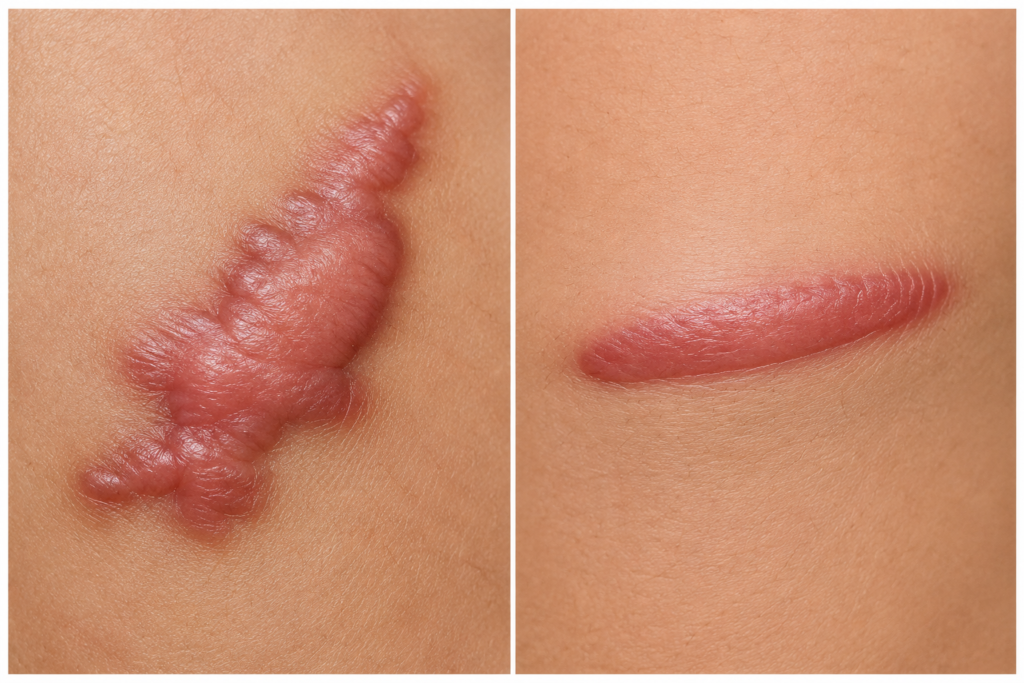
Keloid vs. Hypertrophic Scar: What’s the Difference?
Scars are a natural part of the skin’s healing process after an injury, surgery, burns, acne, or piercings. In some people, scars become raised and thick during healing. These raised scars are commonly classified as keloids or hypertrophic scars.
Although they may look similar, they are different conditions with different growth patterns, behaviour, and treatment approaches. Knowing the difference can help you seek the right treatment at the right time.
What Is a Keloid?
A keloid is an abnormal scar that grows beyond the boundaries of the original wound. It forms because the body produces excess collagen during the healing process.
Unlike normal scars, keloids may continue to grow even after the wound has healed and usually do not disappear without treatment.
Common Features
* Raised, thick, and firm
* Smooth or shiny surface
* May be pink, red, brown, or darker than the surrounding skin
* Can be itchy, painful, or tender
* Continues to grow beyond the original wound
Common Sites
* Earlobes
* Chest
* Shoulders
* Upper back
* Jawline
What Is a Hypertrophic Scar?
A hypertrophic scar is also a raised scar, but it remains within the boundaries of the original wound.
It usually develops within a few weeks after an injury and often becomes flatter and less noticeable over time.
Common Features
* Raised and thick
* Red or pink in the early stages
* May feel itchy or slightly uncomfortable
* Does not grow beyond the original wound
* Often improves gradually with time
Keloid vs. Hypertrophic Scar
* Growth: Keloids grow beyond the original wound, whereas hypertrophic scars remain within the original wound.
* Size: Keloids may continue to grow over time, while hypertrophic scars usually stop growing after the wound heals.
* Appearance: Keloids are thick, raised, smooth, and shiny. Hypertrophic scars are raised and thick but are limited to the area of the wound.
* Symptoms: Keloids are more likely to cause itching, pain, or tenderness. Hypertrophic scars may cause mild itching or discomfort.
* Common Sites: Keloids commonly occur on the earlobes, chest, shoulders, and upper back. Hypertrophic scars can develop anywhere on the body after an injury or surgery.
* Natural Course: Keloids usually do not go away on their own, whereas hypertrophic scars often become flatter and less noticeable over time.
* Recurrence: Keloids have a higher chance of coming back after treatment. Hypertrophic scars are less likely to recur.
* Treatment: Keloids often require specialised treatment by a dermatologist. Hypertrophic scars may improve with conservative treatment, though some cases also benefit from dermatologist-guided care.
Simple way to remember:
* Keloid = Grows beyond the wound.
* Hypertrophic scar = Stays within the wound.
What Causes These Scars?
Both keloids and hypertrophic scars can develop after:
* Cuts and injuries
* Surgical wounds
* Burns
* Acne
* Ear piercing
* Vaccination scars
* Chickenpox scars
However, keloids are more likely to occur in people with a family history of keloids or a genetic tendency to develop excessive scar tissue.
Who Is More Likely to Develop Keloids?
You may be at a higher risk if you:
* Have a family history of keloids.
* Have developed a keloid before.
* Have darker skin.
* Are between 10 and 30 years of age.
* Have repeated skin injuries or piercings.
Why Is It Important to Know the Difference?
Although both scars are raised, they do not behave the same way.
A hypertrophic scar often improves naturally over time or responds well to conservative treatment. In contrast, a keloid may continue to enlarge and usually requires specialised treatment to control its growth and reduce the risk of recurrence.
An early diagnosis by a dermatologist helps determine the correct type of scar and the most suitable treatment plan.
Treatment Options
Treatment depends on the type, size, location, and symptoms of the scar.
Your dermatologist may recommend:
* Silicone gel or silicone sheets
* Corticosteroid injections
* Cryotherapy (for selected keloids)
* Laser therapy
* Pressure therapy (in selected cases)
* Surgical removal in carefully selected patients, usually combined with other treatments to reduce recurrence
Since keloids have a higher chance of returning after treatment, a combination of therapies often provides the best results.
Why Early Dermatologist Consultation Matters
Many people ignore raised scars until they become large, painful, or affect their appearance. However, early treatment can improve outcomes, especially in people prone to keloids.
Consulting a dermatologist early can:
* Help identify whether the scar is a keloid or a hypertrophic scar.
* Prevent the scar from becoming larger.
* Reduce itching, pain, and discomfort.
* Improve cosmetic appearance.
* Lower the chance of recurrence with appropriate treatment.
Early intervention is especially important if you have had keloids before or have developed a raised scar after surgery, burns, acne, or ear piercing.
When Should You See a Dermatologist?
* Your scar continues to grow.
* The scar extends beyond the original wound.
* It becomes itchy, painful, or tender.
* It affects your appearance or confidence.
* You have developed multiple keloids.
* You have had keloids in the past.
FAQ :
1. Can a hypertrophic scar become a keloid?
No. They are different types of scars. However, they may look similar in the early stages, so a dermatologist’s evaluation is important.
2. Do keloids disappear on their own?
No. Most keloids do not disappear without treatment and may continue to grow.
3. Are keloids dangerous?
No. Keloids are not cancerous, but they can cause itching, pain, discomfort, and cosmetic concerns.
4. Can keloids come back after treatment?
Yes. Keloids have a higher chance of recurring than hypertrophic scars. Your dermatologist may recommend combination treatment to reduce this risk.
Conclusion :
Keloids and hypertrophic scars are both raised scars, but they are not the same. A hypertrophic scar stays within the original wound and often improves with time, whereas a keloid grows beyond the wound and usually requires medical treatment.
If you notice a raised scar that continues to grow, becomes itchy or painful, or affects your confidence, do not ignore it. Early consultation with a dermatologist can help identify the type of scar, start the right treatment at the right time, and improve both the appearance of the scar and your overall skin health.
