
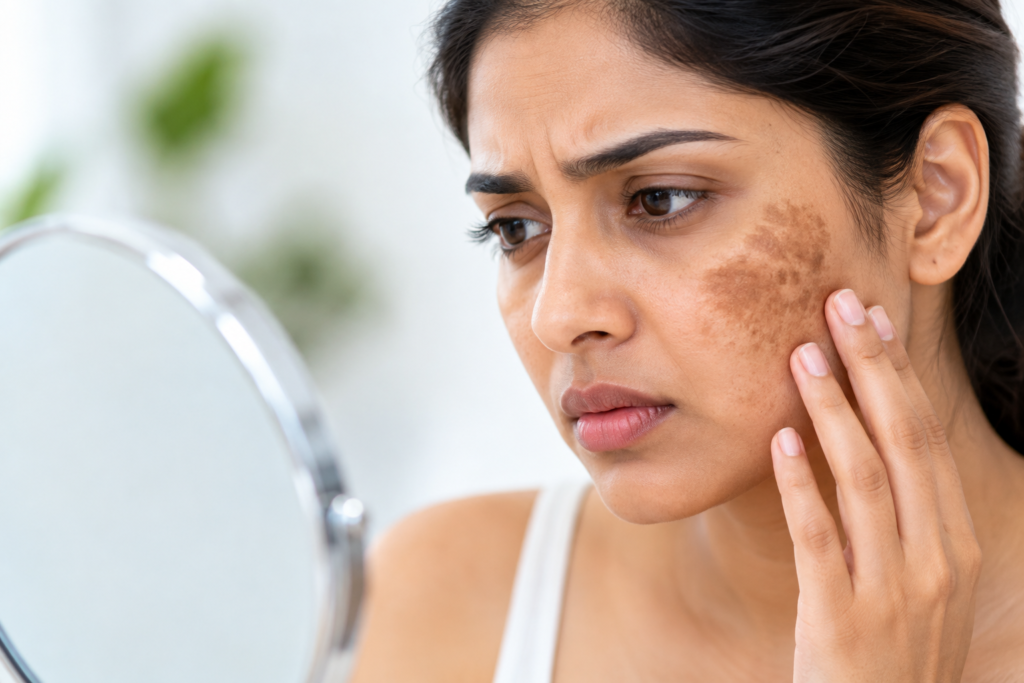
Dark Patches on Face: Why Do They Appear and How Can They Be Treated?
Dark patches on the face are a common skin concern. They may appear as brown, grey, or black areas on the cheeks, forehead, upper lip, nose, or around the eyes. In dermatology, this is broadly referred to as facial hyperpigmentation.
Although facial pigmentation is usually harmless, the underlying cause can vary considerably. Melasma, sun exposure, acne marks, skin inflammation, hormonal changes, medications, and certain skin conditions can all cause dark patches on the face.
Because treatment depends on the cause and depth of pigmentation, identifying the type of pigmentation is an important first step.
What Causes Dark Patches on the Face?
The skin gets its colour primarily from a pigment called melanin, produced by melanocytes. When melanin production or deposition increases in a particular area, the skin can appear darker.
Some of the most common causes include:
1. Melasma
Melasma is one of the most common causes of patchy facial pigmentation, particularly in women.
It typically appears as symmetrical brown or grey-brown patches on:
- Cheeks
- Forehead
- Upper lip
- Nose
- Chin
Sun exposure and hormonal influences can contribute to melasma. Pregnancy, oral contraceptives and other hormonal factors may be associated with its development.
Melasma can be persistent and may recur even after successful treatment.
2. Sun-Induced Pigmentation
Repeated exposure to ultraviolet (UV) radiation can stimulate melanin production.
Sun exposure can contribute to:
- Freckles
- Solar lentigines
- Worsening of melasma
- General facial tanning
- Persistent hyperpigmentation
Without adequate sun protection, pigmentation treatments may be less effective and pigmentation may return.
3. Post-Inflammatory Hyperpigmentation
Dark patches can develop after inflammation or injury to the skin. This is called post-inflammatory hyperpigmentation (PIH).
It may occur following:
- Acne
- Pimples
- Eczema
- Allergic reactions
- Skin infections
- Burns
- Picking or scratching
- Cosmetic procedures
PIH is particularly noticeable in people with darker skin tones.
4. Acne Marks
Acne can leave brown or dark marks even after the active acne has disappeared.
These marks are usually a form of post-inflammatory hyperpigmentation rather than permanent scars.
Treating the underlying acne is important because repeated inflammation can produce new pigmentation.
5. Pigmentation From Skin-Care Products
Certain cosmetics or skin-care products can irritate the skin.
Repeated irritation may cause inflammation followed by pigmentation. This can sometimes occur with:
- Harsh exfoliants
- Strong active ingredients
- Fragrances
- Hair-removal products
- Inappropriate bleaching products
- Unregulated fairness products
If pigmentation started after introducing a new product, the product and the pattern of pigmentation should be assessed.
6. Hormonal Factors
Hormonal changes can influence pigmentation, particularly in melasma.
Pigmentation may become more noticeable during:
- Pregnancy
- Use of certain hormonal medications
- Other hormonal changes
However, not every case of facial pigmentation is caused by hormones.
7. Medications and Medical Conditions
Certain medications can cause changes in skin pigmentation.
Less commonly, facial pigmentation can be associated with underlying medical conditions. The clinical pattern, medical history and other symptoms help determine whether further evaluation is necessary.
For this reason, persistent or unusual pigmentation should not automatically be assumed to be melasma.
How Does a Dermatologist Diagnose Dark Patches?
Treatment should ideally begin with identifying the cause and depth of pigmentation.
A dermatologist may assess:
Clinical examination
The distribution, colour, borders and symmetry of the pigmentation can provide important diagnostic clues.
Dermoscopy
Dermoscopy can help visualize pigment patterns that may not be obvious to the naked eye and can assist in distinguishing different causes of pigmentation.
Wood’s lamp examination
In selected cases, a Wood’s lamp may provide additional information about the pigmentation, although it does not reliably determine the depth of pigmentation in every patient, particularly in darker skin types.
Medical history
The dermatologist may ask about:
- Duration of pigmentation
- Sun exposure
- Pregnancy or hormonal medications
- Previous acne or skin inflammation
- Skin-care products
- Cosmetic procedures
- Previous pigmentation treatments
- Medications
Accurate diagnosis is important because the wrong treatment can sometimes worsen pigmentation.
How Are Dark Patches on the Face Treated?
There is no single treatment that works for every type of facial pigmentation.
Treatment is selected according to the diagnosis, pigmentation depth, skin type and severity.
1. Sun Protection
Sun protection is one of the most important components of pigmentation management.
A dermatologist may recommend:
- Broad-spectrum sunscreen
- Regular application
- Reapplication when appropriate
- Hats or other physical protection
- Avoiding prolonged direct sun exposure
For patients with melasma or recurrent pigmentation, visible light can also be relevant, and tinted sunscreens containing iron oxides may be considered.
2. Topical Treatments
Depending on the diagnosis, dermatologists may prescribe topical agents such as:
- Hydroquinone
- Azelaic acid
- Retinoids
- Kojic acid
- Vitamin C
- Cysteamine
- Tranexamic acid
- Other pigment-modulating ingredients
The appropriate medication, concentration and duration depend on the patient’s skin and the underlying condition.
Strong bleaching agents should not be used continuously without medical supervision.
3. Chemical Peels
Chemical peels can be useful for selected types of superficial pigmentation.
Commonly used peeling agents include:
- Glycolic acid
- Salicylic acid
- Lactic acid
- Jessner-type formulations
- Other dermatologist-selected peeling agents
Peels must be carefully selected because excessive irritation or inflammation can cause post-inflammatory hyperpigmentation, particularly in darker skin types.
4. Laser and Light-Based Treatments
Certain lasers and light-based devices may be considered for selected pigmentation disorders.
However, these treatments are not automatically suitable for every patient.
In particular, patients with darker skin types may have a higher risk of treatment-related pigmentation changes. Device selection, settings and patient selection are therefore important.
5. Oral Treatments
For selected patients with conditions such as melasma, dermatologists may consider systemic treatment.
Oral tranexamic acid, for example, has been used in selected cases of melasma. However, it is not suitable for everyone and requires appropriate medical evaluation before use.
Oral treatment should be prescribed based on the individual’s medical history and risk factors.
How Long Does It Take for Dark Patches to Improve?
The response time varies considerably.
Factors include:
- Underlying cause
- Depth of pigmentation
- Skin type
- Duration of pigmentation
- Degree of sun exposure
- Ongoing inflammation
- Treatment adherence
- Tendency for pigmentation to recur
Some superficial pigmentation may improve over several weeks to months, while conditions such as melasma often require long-term maintenance treatment.
It is important to have realistic expectations. Pigmentation usually fades gradually rather than disappearing immediately.
Why Does Facial Pigmentation Come Back?
Recurrence is common with certain pigmentation disorders, especially melasma.
Possible triggers include:
- Sun exposure
- Visible light
- Hormonal factors
- Heat
- Skin irritation
- Inadequate maintenance treatment
Therefore, successful pigmentation management often involves both initial treatment and long-term prevention.
Can Home Remedies Remove Dark Patches?
Home remedies such as lemon juice, baking soda or harsh scrubs are not recommended for treating facial pigmentation.
They can irritate the skin and potentially cause inflammation, which may make pigmentation worse.
A simple skin-care routine with gentle cleansing, appropriate moisturization and consistent sun protection is generally preferable.
When Should You See a Dermatologist?
Consider seeing a dermatologist if:
- The pigmentation is persistent or progressively increasing.
- Dark patches appear without an obvious reason.
- Pigmentation is affecting large areas of the face.
- Over-the-counter products have not helped.
- Pigmentation repeatedly returns after treatment.
- The patch is unusual, asymmetric or changing.
- There is associated itching, scaling, bleeding or other skin changes.
- You are considering chemical peels or laser treatment.
A dermatologist can determine whether the pigmentation is due to melasma, PIH, sun-induced pigmentation or another condition and recommend an appropriate treatment plan.
FAQs:
1. Are dark patches on the face always melasma?
No. Dark patches can result from melasma, post-inflammatory hyperpigmentation, sun exposure, acne, medications, irritation and several other causes. Diagnosis is important before starting treatment.
2. Can dark patches on the face be completely removed?
Some types of pigmentation can fade substantially, but the outcome depends on the underlying cause. Conditions such as melasma can recur and may require long-term maintenance.
3. Does sunscreen really help facial pigmentation?
Yes. UV exposure can stimulate pigmentation and worsen several pigmentation disorders. Consistent sun protection is an important part of treatment.
4. Can acne cause permanent dark patches?
Acne can cause post-inflammatory hyperpigmentation. These marks often fade gradually, although the process can take months, particularly in darker skin types.
5. Are laser treatments safe for facial pigmentation?
Laser treatment can be useful for selected conditions, but it is not appropriate for every patient. In darker skin types, inappropriate laser settings can increase the risk of pigmentation changes.
6. How can I find out what type of pigmentation I have?
A dermatologist can examine the distribution and appearance of the pigmentation and may use tools such as dermoscopy or Wood’s lamp examination when appropriate.
Conclusion :
Dark patches on the face can have many different causes, and the treatment depends on identifying the underlying condition. Melasma, sun-induced pigmentation, acne-related pigmentation and post-inflammatory hyperpigmentation are among the common causes.
Effective management usually combines accurate diagnosis, appropriate topical or procedural treatment, and consistent sun protection.
If facial pigmentation is persistent, recurrent or difficult to treat, consultation with a dermatologist can help determine the cause and develop a treatment plan suited to your skin type.
