
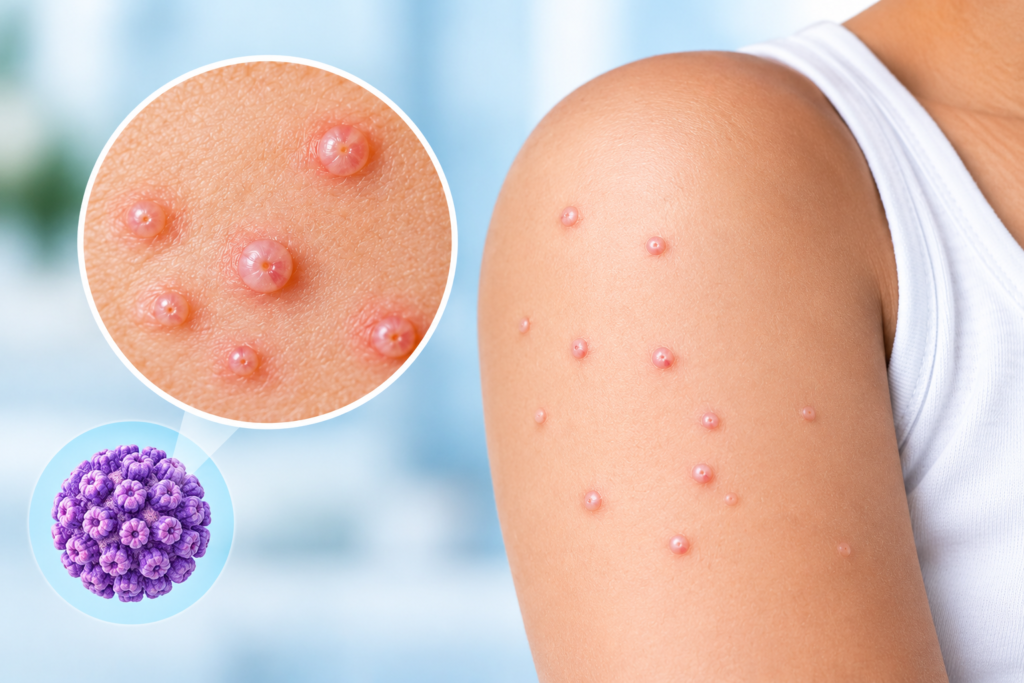
Molluscum Contagiosum: Transmission, Treatment and Prevention
Molluscum contagiosum is a common viral skin infection that causes small, smooth, raised bumps on the skin. It can affect children and adults and may appear on the face, trunk, arms, legs, or genital region.
In adults, genital molluscum contagiosum is particularly important because it can spread through intimate skin-to-skin contact, including sexual contact. Although the condition is generally harmless, the lesions may spread, persist for months, or cause concern because they can resemble genital warts and other skin conditions.
Several treatment options are available, including electrocautery, cryotherapy, and curettage. The appropriate approach depends on the number, size, and location of lesions, as well as individual preferences.
What Is Molluscum Contagiosum?
Molluscum contagiosum is caused by the molluscum contagiosum virus (MCV), a member of the poxvirus family.
The infection typically appears as small, firm, dome-shaped bumps that are skin-coloured, pink, or pearly. A characteristic feature is a tiny central indentation known as umbilication.
When lesions occur around the penis, scrotum, vulva, pubic region, groin, or inner thighs, the condition is referred to as genital molluscum contagiosum.
How Does Molluscum Contagiosum Spread?
The virus spreads mainly through direct contact with infected skin. Common routes of transmission include:
- Sexual contact: Intimate skin-to-skin contact can transmit genital molluscum, even without penetrative intercourse.
- Direct skin contact: Touching infected lesions may spread the virus to another person or another area of the same body.
- Shaving and waxing: Grooming over affected skin can spread the infection to nearby areas.
- Contaminated personal items: Sharing towels or grooming equipment may contribute to transmission.
Condoms can reduce the risk of several sexually transmitted infections but cannot completely prevent molluscum transmission because affected skin may lie outside the area covered.
What Are the Symptoms of Molluscum Contagiosum?
Common symptoms include:
- Small, smooth, round, skin-coloured or pearly bumps.
- A central dimple in some lesions.
- Multiple bumps clustered together.
- Mild itching, redness, or irritation.
- New lesions developing near existing bumps.
The lesions are usually painless. However, genital molluscum can resemble genital warts, folliculitis, and other conditions. A dermatologist’s examination helps establish the correct diagnosis.
Treatment Options for Molluscum Contagiosum
Molluscum contagiosum may resolve naturally as the immune system clears the virus. However, active treatment can be considered when lesions are persistent, spreading, troublesome, or located in the genital region.
The choice of treatment depends on the clinical presentation and the patient’s individual needs.
- Electrocautery
Electrocautery is an important procedural option for removing selected molluscum contagiosum lesions. It uses controlled heat generated by electrical equipment to destroy targeted lesions.
During the procedure, the dermatologist examines the affected skin, cleans the treatment area, and may use local anaesthesia depending on the number and location of lesions. The selected bumps are then treated carefully using an appropriate technique.
Potential advantages of electrocautery include:
- Targeted removal of selected visible lesions.
- The ability to treat multiple suitable lesions during a clinical session.
- A useful option for persistent or spreading lesions.
- Treatment that can be tailored to the affected area.
Electrocautery may also be considered for selected genital lesions. However, genital skin is particularly sensitive, so treatment requires careful technique and appropriate clinical expertise.
Possible side effects include temporary discomfort, burns, changes in skin pigmentation, and scarring. Healing time varies according to the treatment area and extent of treatment.
It is important to understand that electrocautery destroys the treated lesions but does not guarantee that new lesions will not appear. Follow-up or additional treatment may sometimes be necessary.
- Cryotherapy
Cryotherapy involves applying liquid nitrogen to freeze and destroy individual lesions. It can be useful in selected cases, although temporary pain, blistering, and pigment changes may occur.
- Curettage
Curettage involves removing individual lesions with a suitable medical instrument. It can provide immediate physical removal of selected bumps, but local anaesthesia may be required. Bleeding, discomfort, pigment changes, and scarring are possible.
- Topical Treatments
Certain topical treatments may be considered in selected patients, depending on the location and clinical circumstances. However, products suitable for lesions on the arms or trunk may not be appropriate for genital skin.
Avoid applying ordinary wart-removal acids, chemical preparations, or home remedies to genital lesions without medical advice.
- Observation and Natural Resolution
Some lesions disappear without treatment, although resolution can take several months or longer. Observation may be appropriate in selected cases after the diagnosis has been confirmed and transmission precautions have been discussed.
For genital lesions, medical assessment is advisable before deciding on treatment or observation.
How Can Molluscum Contagiosum Be Prevented?
The following precautions can help reduce transmission:
- Avoid scratching, squeezing, or picking the lesions.
- Avoid shaving or waxing over affected skin.
- Do not share towels, razors, or grooming equipment.
- Wash your hands after touching lesions or applying prescribed treatment.
- Avoid sexual contact involving affected skin until lesions have resolved or a clinician has advised you about precautions.
- Seek medical evaluation if new genital bumps appear.
If genital molluscum is suspected, a clinician may also recommend STI testing based on the patient’s history and individual risk.
When Should You Consult a Dermatologist?
Consult a dermatologist if you notice unexplained bumps on the genital region or other areas of the body, particularly when lesions are spreading, persistent, inflamed, or difficult to distinguish from genital warts.
Early assessment helps confirm the diagnosis and determine whether electrocautery, cryotherapy, curettage, observation, or another approach is appropriate.
Conclusion
Molluscum contagiosum is a common viral skin infection that spreads through direct contact and can affect both genital and non-genital areas. Although it may resolve naturally, treatment can help manage persistent or troublesome lesions.
Electrocautery is one option for removing selected lesions, alongside cryotherapy, curettage, topical approaches in appropriate cases, and observation. The best choice depends on the patient’s condition, the affected area, and the potential benefits and risks of each approach.
If you notice unexplained skin bumps, especially around the genital region, consult a qualified dermatologist for an accurate diagnosis and personalised treatment plan.
FAQs
1. What is molluscum contagiosum?
Molluscum contagiosum is a viral skin infection that causes small, smooth bumps, often with a central indentation.
2. How does molluscum contagiosum spread?
It spreads mainly through direct skin contact, including intimate sexual contact when genital skin is affected. Shaving and sharing contaminated personal items may also contribute to transmission.
3. What is the best treatment for molluscum contagiosum?
Treatment depends on the number, location, and severity of the lesions. Electrocautery, cryotherapy, curettage, selected topical treatments, and observation may be considered.
4. Can electrocautery remove molluscum contagiosum?
Yes. Electrocautery can destroy selected visible lesions during a clinical procedure. New lesions may still develop, and additional treatment may sometimes be required.
5. Is genital molluscum contagiosum a sexually transmitted infection?
It can be transmitted through sexual skin-to-skin contact, but it is not exclusively sexually transmitted.
6. Can molluscum contagiosum disappear naturally?
Yes. The immune system can clear the infection without treatment, although lesions may persist for several months or longer.
7. Can molluscum contagiosum recur after treatment?
Yes. New lesions may appear after treatment because of previously unnoticed lesions or the time between infection and visible symptoms.
8. Is molluscum contagiosum the same as genital warts?
No. Molluscum contagiosum is caused by a poxvirus, while genital warts are generally caused by human papillomavirus (HPV). A clinical examination helps distinguish them.
9. Can I remove molluscum contagiosum at home?
Home removal is not recommended. Squeezing, cutting, or burning lesions can cause infection, scarring, and further spread.
10. Which doctor treats molluscum contagiosum?
A dermatologist can diagnose molluscum contagiosum and recommend suitable treatment based on the lesion location, symptoms, and individual circumstances.
